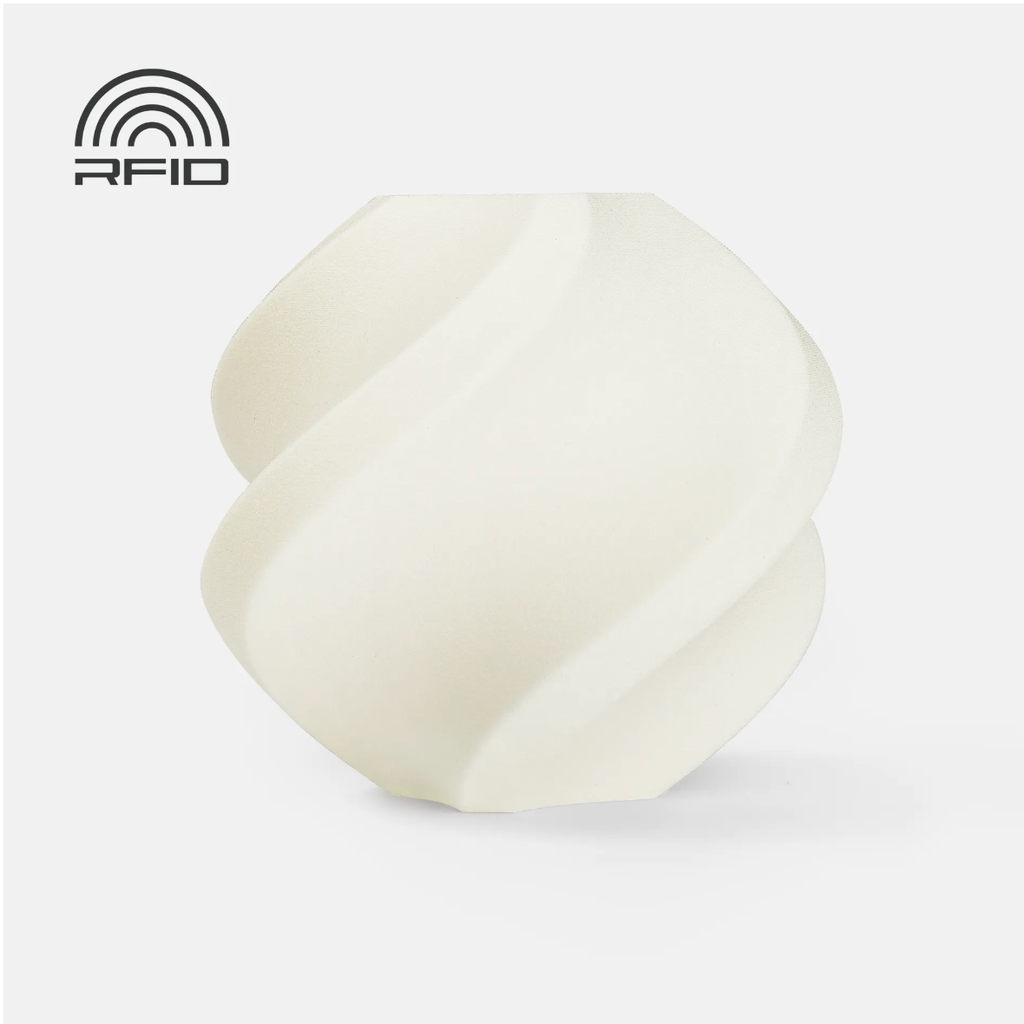
PLA Aero
- Specialized for printing 3D RC planes
- Relatively tough with good impact resistance
- Easy to paint with matte texture
Cautions for Use
- Recommended to dry out before use
- All AMS Series Compatible
Low Density and Light Weight
Bambu PLA Aero has almost the same filament density as regular PLA, while the prints density is only 50% to 80%.
* When printing models of the same volume, PLA Aero is about half the weight of PLA Basic.
Controllable Model Density
Achieve lower density of the prints by increasing printing temperature and lowering flow rate.
* The average density of prints will vary with changes in parameters such as actual printing temperature, flow rate ratio, printing speed, model size, wall thickness and infill density.
|
| Toughness (Impact Strength - XY) | 32.0 kJ/m² | 24.5 kJ/m² | 7.9 kJ/m² |
| Layer Adhesion (Impact Strength - Z, Dry State) | 3.4 kJ/m² | 2.5 kJ/m² | 1.1 kJ/m² |
| Layer Strength (Bending Strength - Z) | 24 MPa | 15 MPa | 15 MPa |
Ultra-lightweight, Controllable Density
Only 50%-75% the density of regular ASA prints, ASA Aero is as light as feather, designed for weight-sensitive objects, such as RC planes and unmanned aerial vehicles (UAVs). With controllable foaming characteristic, ASA Aero achieves lower density of prints by increasing printing temperature or lowering flow rate.
The average density of prints will vary with changes in parameters such as actual printing temperature, flow rate ratio, printing speed, model size, wall thickness and infill density.
|
| Printing Temperature | Increases ↗ | Decreases ↘ |
| Printing Speed | Increases ↗ | Stable or Increases ↗ |
| Flow Rate Ratio | Increases ↗ | Increases ↗ |
| Model Size | Increases ↗ | Decreases ↘ |
| Wall Thickness (Wall loops) | Increases ↗ | Increases ↗ |
| Infill Density | Increases ↗ | Increases ↗ |
The relationship between the maximum foaming rate, minimum print density, and printing temperature of ASA Aero. * Specimen Test: Nozzle Type: 0.4 mm; Printing Speed: 80 mm/s; Model size (L*W*H): 80*10*4 mm³ (the XY direction) The actual required flow rate ratio and final model density may vary with different models.
|
| Printing Temperature | Increases ↗ | Decreases ↘ |
| Printing Speed | Increases ↗ | Stable or Increases ↗ |
| Flow Rate Ratio | Increases ↗ | Increases ↗ |
| Model Size | Increases ↗ | Decreases ↘ |
| Wall Thickness (Wall loops) | Increases ↗ | Increases ↗ |
| Infill Density | Increases ↗ | Increases ↗ |
The relationship between the maximum foaming rate, minimum print density, and printing temperature of PLA Aero. * Specimen Test: Nozzle Type: 0.4 mm; Printing Speed: 80 mm/s; Model size (L*W*H): 80*10*4 mm³ (the XY direction) The actual required flow rate ratio and final model density may vary with different models.
|
| 190 °C | ~ 0.95 | ~ 100% | ~ 0% | ~ 1.17 g/cm³ |
| 200 °C | 0.89 | 110% | 10% | 1.06 g/cm³ |
| 210 °C | 0.85 | 115% | 15% | 1.02 g/cm³ |
| 220 °C | 0.76 | 129% | 29% | 0.91 g/cm³ |
| 230 °C | 0.62 | 158% | 58% | 0.74 g/cm³ |
| 240 °C | 0.45 | 217% | 117% | 0.54 g/cm³ |
| 250 °C | 0.38 | 258% | 158% | 0.45 g/cm³ |
| 260 °C | 0.35 | 280% | 180% | 0.42 g/cm³ |
| 270 °C | 0.37 | 265% | 165% | 0.44 g/cm³ |
Tough with Good Impact Resistance
Compared to pre-foaming Wood PLA, Bambu PLA Aero and its prints are tougher and more resistant to impact, collision, and falling.
Matte Finish For Easy Coloring
Bambu PLA Aero provides an easy-to-color matte surface texture with better dyeing results as compared to PLA Basic.
Parameters Comparison
|
| Printing Temperature | 220 - 260 ℃ | 190 - 230 ℃ |
| Printing Speed | < 180 mm/s | < 300 mm/s |
| Flow Rate Ratio | 0.5 - 0.8 | 0.96 - 1 |
| Filament Density | 1.21 g/cm³ | 1.24 g/cm³ |
| Foaming Rate | 0 - 120% | / |
| Prints Density | 0.55 - 1.05 g/cm³ | 1.21 g/cm³ |
RFID for Intelligent Printing
All printing parameters are embedded in RFID, which can be read through our AMS (Automatic Material System).
Printing Tips
1.Accessory Compatibility
Not compatible with Hotend with Hardened Steel Nozzle 0.6 mm / 0.8 mm, and Hotend with Stainless Steel Nozzle 0.2 mm.
2.Drying Recommendations
PLA Aero is highly sensitive to humidity. To achieve optimal printing performance, it is recommended further drying before use and after storage. For more details, please refer to the
filament drying instructions on WIKI.
3.AMS Compatibility Warning
PLA Aero filament is relatively soft which may result in material loading and unloading failures during AMS printing.
4.Printing RC model
5.Safety Tips
1. Please store the filament in a cool, dark, and dry environment away from direct sunlight and high temperatures.
2. Please keep filament and any broken fragments out of reach of infants, children, and pets to prevent swallowing or choking.
3. For opened filament, we recommend drying before use according to the wiki’s recommended temperature and time settings.
4. Please print this filament in a well-ventilated area, or install an effective air filtration or exhaust system.
5. As this filament is not food-grade, please avoid using finished prints for food storage or contact.