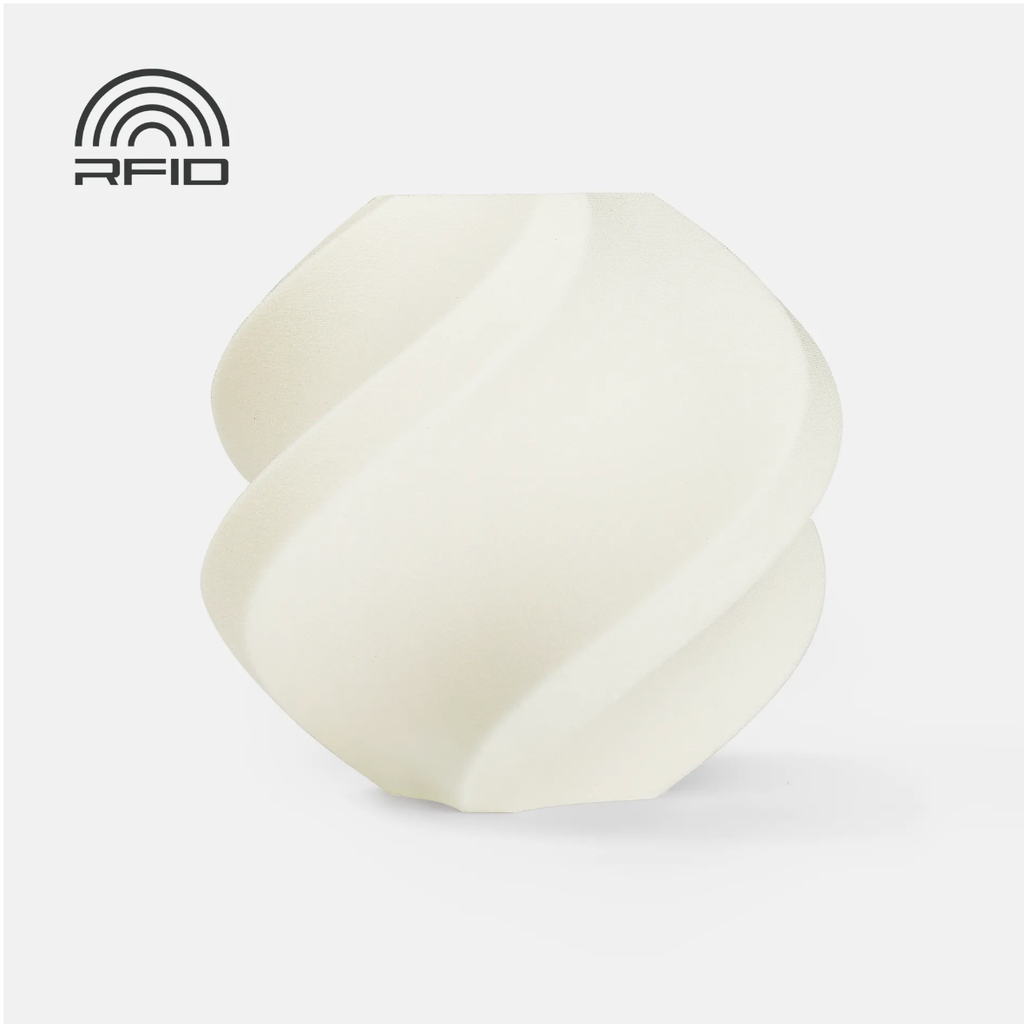
ASA Aero
· Tough with Good Impact Resistance · Ultra-lightweight & Low Density · Water & UV Resistance
Impact Resistance & Built to Last
Compared with other foaming filament, ASA Aero is tougher with higher layer strength, making it more resistant to impact, collision, and falling, perfect for high-stress demanding applications.
|
| Toughness (Impact Strength - XY) | 32.0 kJ/m² | 24.5 kJ/m² | 7.9 kJ/m² |
| Layer Adhesion (Impact Strength - Z, Dry State) | 3.4 kJ/m² | 2.5 kJ/m² | 1.1 kJ/m² |
| Layer Strength (Bending Strength - Z) | 24 MPa | 15 MPa | 15 MPa |
Ultra-lightweight, Controllable Density
Only 50%-75% the density of regular ASA prints, ASA Aero is as light as feather, designed for weight-sensitive objects, such as RC planes and unmanned aerial vehicles (UAVs). With controllable foaming characteristic, ASA Aero achieves lower density of prints by increasing printing temperature or lowering flow rate.
The average density of prints will vary with changes in parameters such as actual printing temperature, flow rate ratio, printing speed, model size, wall thickness and infill density.
|
| Printing Temperature | Increases ↗ | Decreases ↘ |
| Printing Speed | Increases ↗ | Stable or Increases ↗ |
| Flow Rate Ratio | Increases ↗ | Increases ↗ |
| Model Size | Increases ↗ | Decreases ↘ |
| Wall Thickness (Wall loops) | Increases ↗ | Increases ↗ |
| Infill Density | Increases ↗ | Increases ↗ |
The relationship between the maximum foaming rate, minimum print density, and printing temperature of ASA Aero. * Specimen Test: Nozzle Type: 0.4 mm; Printing Speed: 80 mm/s; Model size (L*W*H): 80*10*4 mm³ (the XY direction) The actual required flow rate ratio and final model density may vary with different models.
|
| 220 °C | ~ 0.93 | ~ 100% | ~ 0% | ~ 0.97 g/cm³ |
| 230 °C | 0.90 | 106% | 6% | 0.92 g/cm³ |
| 240 °C | 0.74 | 128% | 28% | 0.78 g/cm³ |
| 250 °C | 0.60 | 158% | 58% | 0.61 g/cm³ |
| 260 °C | 0.51 | 186% | 86% | 0.52 g/cm³ |
| 270 °C | 0.45 | 211% | 111% | 0.46 g/cm³ |
| 280 °C | 0.44 | 216% | 116% | 0.45 g/cm³ |
Ready for Harsh Environment & Outdoor
Compared with PLA Aero, the overwhelming performance in temperature, water, and UV resistance makes ASA Aero stand out for long-lasting outdoor use and harsh environments.
|
| Heat Deflection Temperature / °C (0.45 MPa) | 53 °C | 57 °C | 85 °C | 100 °C |
Matte Finish For Easy Coloring
Bambu ASA Aero provides an easy-to-color matte surface texture with better dyeing results as compared with regular ASA.
Parameters Comparison
|
| Printing Temperature | 240 - 270 °C | 240 - 280 °C | 210 - 260 °C |
| Printing Speed | < 250 mm/s | < 150 mm/s | < 180 mm/s |
| Flow Rate Ratio | 0.93 - 0.97 | 0.45 - 0.80 | 0.5 - 0.8 |
| Filament Density | 1.05 g/cm³ | 0.99 g/cm³ | 1.21 g/cm³ |
| Foaming Rate | / | 0 - 110% | 0 - 120% |
| Volumetric Expansion Ratio | 102% | 100% - 210% | 100% - 220% |
| Prints Density | 1.03 g/cm³ | 0.46 ~ 0.97 g/cm³ | 0.55 - 1.05 g/cm³ |
RFID for Intelligent Printing
All printing parameters are embedded in RFID, which can be read through our AMS (Automatic Material System).
Printing Tips
1.Accessory Compatibility
Not compatible with Cool Plate SuperTack, Hotend with Hardened Steel Nozzle 0.6 mm / 0.8 mm, and Hotend with Stainless Steel Nozzle 0.2 mm.
2.Drying Recommendations
ASA Aero is highly sensitive to humidity. To achieve optimal printing performance, it is recommended further drying before use and after storage. For more details, please refer to the
filament drying instructions on WIKI.
3.Warping Prevention Tips
To minimize warping, avoid printing large-sized high infill density models. Use enclosed printers and ensure the build plate is properly applied with glue for better print adhesion before printing. Set lower printing speed and higher heatbed temperature. For more details, please refer to:
Common print quality problems and solutions on WIKI.
4.Ventilation & Odor Notice
Pungent and unpleasant odors may be released during printing. Make sure your printer is placed in a well-ventilated area and use enclosed printers.
5.Usage Tips
Foaming ASA materials (ASA Aero) have high requirements for material drying and parameter settings. Please carefully read the
ASA Aero Printing Guide before starting the printing process.